
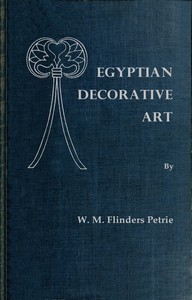
Egyptian decorative art : A course of lectures delivered at the Royal…
Let's be clear from the start: this isn't a novel. Egyptian Decorative Art is a published series of lectures by Sir William Matthew Flinders Petrie. Think of it as a guided tour through three thousand years of design, led by the man who literally wrote the book (many books, actually) on Egyptian archaeology.
The Story
There's no plot in the traditional sense. Instead, Petrie builds an argument. He starts with a simple idea: to understand ancient Egypt, you must understand its art. But not just the big statues and pyramids—the everyday stuff. He takes you through the evolution of patterns on pottery, the symbolism in jewelry, the layout of wall scenes, and the craftsmanship of furniture. He shows how a zigzag pattern from pre-dynastic times evolves into a key decorative motif, or how the choice of blue in a necklace wasn't just about fashion but about invoking the heavens. The 'story' is the revelation of a complete visual language, where nothing was arbitrary and beauty always served a deeper purpose.
Why You Should Read It
What makes this special is Petrie's voice. You're not getting a sterile textbook summary. You're getting his firsthand observations and strong opinions. He gets excited about the precision of a beadmaker and frustrated with later, clumsier Roman copies of Egyptian designs. Reading it, you feel the thrill of discovery alongside him. He makes you see a simple glazed tile not as a museum piece, but as a product of specific techniques, religious ideas, and economic factors. It transforms how you look at things. Suddenly, a museum visit becomes a detective game, looking for the connections and meanings he points out.
Final Verdict
This book is perfect for history buffs, museum lovers, or anyone with a curiosity about ancient cultures who wants to go deeper than picture captions. It's also a fascinating read for artists and designers interested in historical patterns and symbolism. A word of caution: it was written over a century ago, so some archaeological interpretations have been updated. But that almost adds to the charm—you're seeing the foundation being laid. If you enjoy primary sources and listening in on a master's thinking process, you'll find this absolutely absorbing. It's a direct line to the mind of a pioneer, unpacking the silent language of an incredible civilization.
This work has been identified as being free of known copyright restrictions. Enjoy reading and sharing without restrictions.
James Thomas
7 months agoI particularly value the technical accuracy maintained throughout.
Melissa Garcia
1 year agoBeautifully written.
Ava Torres
1 year agoSimply put, the arguments are well-supported by credible references. Exactly what I needed.






Barbara Thomas
1 year agoGiven the current trends in this field, the author manages to bridge the gap between theory and practice effectively. This adds significant depth to my understanding of the field.