
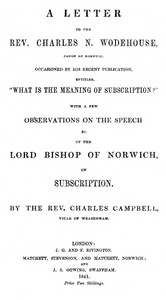
A letter to the Rev. Charles N. Wodehouse, Canon of Norwich, occasioned by his…
Let's set the scene. It's 1855 in England. Religion isn't just a private matter; it's a public conversation that shapes laws, society, and daily life. Charles Campbell, a concerned citizen, picks up a published sermon by the Reverend Charles N. Wodehouse, a Canon of Norwich. As he reads, he gets more and more agitated. He disagrees—strongly—with Wodehouse's views on church doctrine and authority.
The Story
This entire book is Campbell's response. Think of it less as a story with a plot and more as a captured moment of intellectual combat. Campbell structures his letter as a direct, line-by-line critique of Wodehouse's original work. He quotes the Canon's points and then systematically challenges them. He questions interpretations of scripture, debates the role of the church, and argues for what he sees as a purer, more correct form of Christian practice. There's no narrative arc in the traditional sense. The drama comes from the tension of the argument itself, from watching one man's conviction clash with another's published authority.
Why You Should Read It
You should read it to time-travel into a 19th-century mind. This isn't a dry historical document; it's raw, passionate opinion. You can almost hear Campbell's pen scratching furiously across the page. It’s fascinating to see how public debate worked before social media. A disagreement meant researching, writing, printing, and publishing a whole book! It shows how seriously people took ideas. Campbell isn't just mad; he's meticulously, painstakingly mad. He builds his case with care, which makes his occasional flashes of sarcasm or frustration even more powerful. It’s a masterclass in persuasive writing from a different era.
Final Verdict
This book is perfect for history buffs who love primary sources that haven't been sugar-coated, and for anyone curious about the social and religious debates that simmered under the surface of Victorian England. It's also great for writers interested in rhetoric and argument. If you prefer fast-paced novels with clear endings, this might feel slow. But if you enjoy stepping into a real, unfiltered argument from the past and listening to one very determined man make his case, you'll find it utterly compelling. It's a snapshot of a belief system in conflict, and that's always a gripping thing to witness.
This title is part of the public domain archive. Enjoy reading and sharing without restrictions.
Barbara Gonzalez
3 months agoI took detailed notes while reading through the chapters and the wealth of information provided exceeds the average market standard. A mandatory read for anyone in this industry.
John Thomas
2 years agoI started reading this with a critical mind, the concise summaries at the end of each section are a lifesaver. This adds significant depth to my understanding of the field.
Kimberly Jackson
8 months agoAfter finishing this book, it manages to explain difficult concepts in plain English. I will read more from this author.
Donald Robinson
1 year agoThe layout is very easy on the eyes.


Richard Taylor
1 month agoBefore I started my latest project, I read this and the concise summaries at the end of each section are a lifesaver. I am looking forward to the author's next publication.