
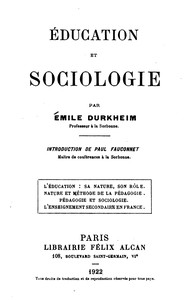
Éducation et sociologie by Émile Durkheim
Don't expect a story with characters and a plot twist. 'Éducation et sociologie' is a collection of essays where Émile Durkheim, one of the founders of sociology, lays out his big idea about what education actually is. He throws out the common-sense notion that it's about developing individual talents. Instead, he makes a compelling case that education is a social fact. Society, in each time and place, creates an 'ideal' of the person it needs—a citizen, a worker, a believer. The entire education system, from what's taught to how students are disciplined, is designed to stamp that ideal onto each new generation.
The Story
There's no narrative arc here, but there is a powerful argument. Durkheim walks us through his logic. He starts by defining education not as a personal choice, but as a methodical socialization. He shows how different societies (like ancient Athens vs. medieval Europe) had wildly different educational goals because they needed different kinds of people. He examines the role of authority in the classroom, arguing it's necessary because the teacher represents society's demands. The book builds to its central point: schools are the essential bridge between the private family and the public world, transforming the child into a social being.
Why You Should Read It
This book changed how I see everything about school. Reading it feels like putting on a pair of X-ray glasses. Suddenly, you see the invisible structures behind parent-teacher nights, standardized tests, and even the way we arrange desks. It explains why education reform is so hard—it's not just changing a lesson plan, it's tinkering with the core machinery of society. Durkheim's ideas make sense of current debates about teaching national history or civic values. It's not just theory; it's a tool for understanding the daily news and your own experiences.
Final Verdict
Perfect for curious readers who enjoy big ideas that explain the everyday world. If you liked the societal insights of Malcolm Gladwell or the historical patterns in Jared Diamond's work, you'll appreciate Durkheim's foundational thinking. This is also a great, accessible entry point into classical sociology. It's for anyone who has ever been a student, is a parent, works in education, or simply wants to understand one of the main forces that shaped them. Be ready to have your assumptions challenged—you might never look at a school the same way again.
This text is dedicated to the public domain. You do not need permission to reproduce this work.
William Martinez
7 months agoA brilliant read that I finished in one sitting.
Michael Wilson
8 months agoClear and concise.
Betty Brown
1 year agoSimply put, it challenges the reader's perspective in an intellectual way. One of the best books I've read this year.
David Anderson
9 months agoHonestly, the atmosphere created is totally immersive. Exactly what I needed.










Patricia Rodriguez
1 year agoI appreciate how this edition approaches the core problem, the structural organization allows for quick referencing of key points. This exceeded my expectations in almost every way.