
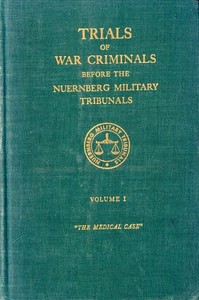
Trials of war criminals before the Nuernberg military tribunals under control…
This isn't a single story with a plot in the traditional sense. Instead, Trials of War Criminals is a massive collection of court documents from the twelve trials held in Nuremberg from 1946 to 1949. These were separate from the famous trial of top Nazi leaders like Göring and Hess.
The Story
The book lays out, case by case, how the Allies prosecuted other key figures. You follow the evidence against groups like the Nazi doctors who performed horrific medical experiments, the Einsatzgruppen death squads, and the powerful industrialists from companies like Krupp and IG Farben. The 'story' here is the legal process itself: the prosecution presenting mountains of evidence, the defense arguments (which often tried to claim 'just following orders'), and the final judgments. It shows the struggle to create a new concept of international law to deal with crimes against humanity.
Why You Should Read It
Reading this is a powerful, sobering experience. You're not getting a historian's summarized take; you're in the room. You see the cold, clinical language used to describe absolute evil. What hit me hardest was seeing how ordinary professions—doctors, lawyers, businessmen—were corrupted. It makes you think deeply about personal responsibility, the power of systems, and the fragile mechanisms of justice. It’s not an easy read, but it’s a necessary one. It strips away the Hollywood drama and shows the gritty, complicated work of holding people accountable.
Final Verdict
This book is for the committed reader who wants to go beyond the headlines of history. It's perfect for anyone interested in World War II, law, ethics, or political science. It’s not a casual page-turner; it’s a reference work and a primary source that demands your attention. If you're looking for a narrative history, start elsewhere. But if you want to confront the real documents that helped define modern human rights law, this is an essential, unforgettable resource.
There are no legal restrictions on this material. Distribute this work to help spread literacy.
Patricia Perez
11 months agoI found the data interpretation to be highly professional and unbiased.
Susan Davis
1 year agoThe digital index is well-organized, making research much faster.
Michael Williams
1 year agoHaving explored several resources on this, I find that the insights into future trends are particularly thought-provoking. This adds significant depth to my understanding of the field.
Linda Lopez
1 year agoI've been looking for a reliable source on this topic, and the narrative arc keeps the reader engaged while delivering factual content. An excellent example of how quality digital books should be formatted.



William Williams
7 months agoComparing this to other titles in the same genre, the narrative arc keeps the reader engaged while delivering factual content. I'm genuinely impressed by the quality of this digital edition.