
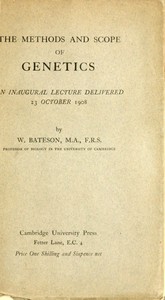
The Methods and Scope of Genetics by William Bateson
Let's be clear from the start: this is not a novel. You won't find any characters in the traditional sense, unless you count sweet peas and guinea pigs. But the story it tells is one of the most dramatic in science. William Bateson's 1908 book is his attempt to define and defend a brand new field of study. The plot is the argument itself.
The Story
The book is built around Bateson's inaugural lecture as a professor at Cambridge. For decades, scientists struggled to explain inheritance. The popular idea was 'blending'—that traits from parents smoothly mixed in offspring. Bateson says this is completely backwards. He champions the rediscovered work of Gregor Mendel, showing through simple experiments with plants and animals that traits are passed down in discrete, unchanging 'units' (what we'd later call genes). He lays out the rules of dominance and recessiveness, shows how traits can hide for a generation and then reappear, and argues that variation in life comes from new combinations of these units, not from blending. The entire book is his case for making this Mendelian method the core of a new science, which he boldly names 'genetics.'
Why You Should Read It
What's fascinating is feeling the heat of the debate. Bateson isn't just reporting facts; he's a missionary for an idea he knows is right. You can sense his frustration with the old guard and his excitement for the future. Reading his clear explanations of Punnett squares and inheritance patterns, you realize how elegant and powerful this simple logic was. It cut through a century of confusion. It's also humbling to see how much they figured out without knowing what a chromosome was, let alone DNA. They were mapping a hidden world using only careful observation and brilliant deduction.
Final Verdict
This book is a must-read for anyone curious about the history of science and how big ideas take root. It's perfect for biology enthusiasts who want to understand the foundational arguments of their field, or for general readers who enjoy seeing a brilliant mind at work, building a new system from the ground up. It's not a casual beach read, but for the right person, it's more thrilling than any mystery novel—because the mystery being solved is the very code of life itself.
You are viewing a work that belongs to the global public domain. You can copy, modify, and distribute it freely.
Susan Taylor
2 months agoIf you're tired of surface-level information, the practical checklists included are a great touch for real-world use. I am looking forward to the author's next publication.
Barbara Martinez
8 months agoAs a professional in this niche, it addresses the common misconceptions in a very professional manner. The price-to-value ratio here is simply unbeatable.
Michael Johnson
6 months agoThe peer-reviewed feel of this content gives me great confidence.
Karen Brown
3 months agoI was particularly interested in the case studies mentioned here, the data points used to support the main thesis are quite robust. This should be on the reading list of every serious professional.






Thomas Moore
2 months agoI found the author's tone to be very professional yet accessible, the bibliography and references suggest a high level of research and authority. I am looking forward to the author's next publication.