
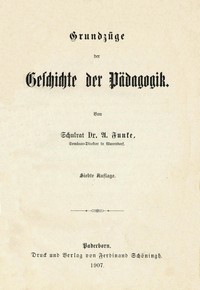
Grundzüge der Geschichte der Pädagogik by C. A. Funke
Let's be clear: this isn't a novel. Grundzüge der Geschichte der Pädagogik is exactly what the title says—a foundational look at the history of educational thought. Written in the late 1800s by German scholar Clemens August Funke, it's a systematic walk from ancient times to his own era.
The Story
Funke structures his book like a historical journey. He starts with the educational ideals of ancient Greece and Rome, where philosophers like Plato first linked learning to citizenship and virtue. He then moves through the Middle Ages, where education was largely tied to the church and monasteries. The story picks up speed with the Renaissance and Reformation, highlighting how printing and new religious ideas changed who got to learn and what they studied. He spends significant time on the Enlightenment, showcasing thinkers like Rousseau and Pestalozzi who championed child-centered learning. Finally, he brings the reader to the educational movements and national school systems of the 19th century, setting the stage for the modern world.
Why You Should Read It
What makes this old book compelling is the perspective. Reading Funke is like getting a snapshot of what a smart, late-19th-century educator believed was important about his field's past. You see which thinkers he elevates and how he interprets their ideas. It’s a primary source about the history of education, itself. You start to recognize that arguments about testing, rote memorization vs. creative thinking, and the role of the state in schooling are centuries old. It gives incredible context to today's headlines about education.
Final Verdict
This book is a specialized pick, but a rewarding one. It's perfect for history buffs, education students, or teachers who want to understand the deep roots of their profession. It's also great for anyone interested in intellectual history and how ideas about childhood and society have evolved. A word of caution: it's a translated, academic work from another time, so the prose can be dense. Don't expect a page-turner. Instead, think of it as a thoughtful, well-organized museum exhibit for your brain. If you've ever asked, 'Why do we do school *this* way?' Funke provides a detailed, historical answer.
Legal analysis indicates this work is in the public domain. It serves as a testament to our shared literary heritage.
David Perez
1 year agoGreat value and very well written.
Donald White
6 months agoIt’s rare to find such a well-structured narrative nowadays, the inclusion of diverse viewpoints strengthens the overall narrative. A rare gem in a sea of mediocre content.
Richard Jackson
6 months agoThe author provides a very nuanced critique of current methodologies.
Ashley Anderson
1 year agoHaving explored several resources on this, I find that the author doesn't just scratch the surface but goes into meaningful detail. This exceeded my expectations in almost every way.




Matthew Gonzalez
1 month agoThe digital formatting makes it very easy to navigate.